Why Decluttering Never Sticks — and the Method That Does
Almost everyone has decluttered a room properly at least once. Almost everyone has watched that room fill up again within a year. The usual explanation is a lack of discipline, and it is wrong.
Decluttering fails for three structural reasons, and none of them is about willpower. Understanding them is what turns a weekend’s work into something permanent.
Reason one: you cleared the output, not the input
A decluttering session removes a stock of objects. It does nothing to the flow of objects arriving.
A typical household brings in a remarkable amount every week: deliveries, packaging, post, free items, children’s school output, gifts, work papers, things bought because they were on offer. If that inflow exceeds the rate at which things leave, the house refills at a predictable speed no matter how thorough the clear-out was.
So the first real change is at the door, not in the cupboard. Unsubscribe from marketing emails and retailer apps — the majority of impulse purchases start there. Register with the mail preference service in your country. Put a rule on discretionary buying: anything over an agreed amount waits 48 hours in a basket or a list before it is bought, which removes most impulse spending without a budget.
For gifts, say something. It feels awkward once and solves the problem for years, especially with grandparents and children’s birthdays where experiences or consumables are usually welcomed as an alternative.
Reason two: you had no capacity limit
Without a limit, “enough” is undefined, and an undefined limit is always exceeded.
The fix is to let containers and shelves define capacity instead of your judgement. One box for each child’s artwork. One drawer for cables. One shelf for board games. One rail’s worth of hanging clothes. When the container is full, something leaves before something enters — and the decision is about which item, not about whether to act.
This works because it converts a vague, guilt-laden judgement into a concrete comparison. “Do we own too many mugs?” is unanswerable. “Which of these two mugs goes, given the shelf holds eight?” takes four seconds.
Leave headroom. A container filled to 100 percent cannot absorb a normal week, and the overflow always lands somewhere with no system at all. Aim for about 80 percent on anything in daily use.
Reason three: leaving the house is too hard
This is the most underestimated factor. A decision to let something go is not the same as it actually leaving, and the gap between them is where decluttering dies.
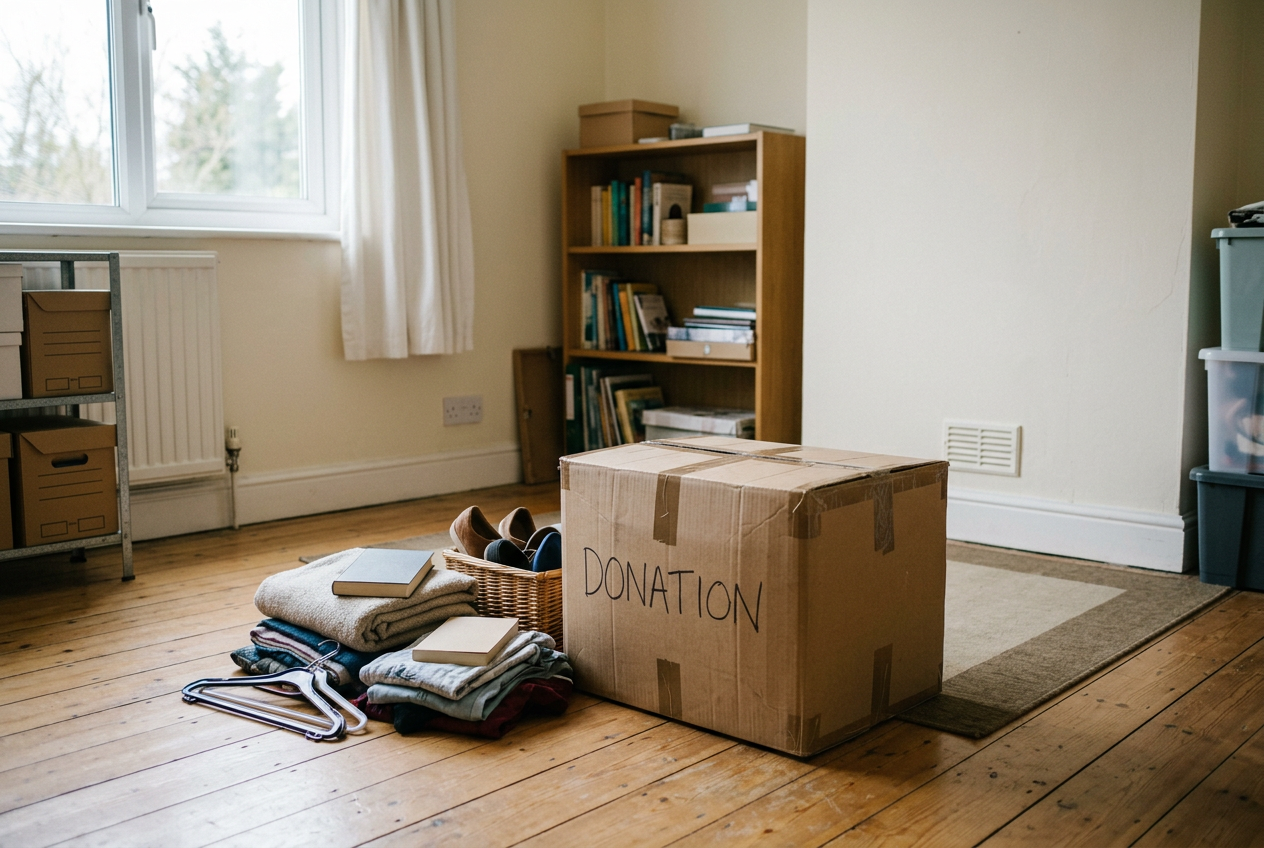
Most households have a donation pile somewhere right now that has been there for months. The decision was made. What blocked it was logistics: finding a bag, filling it, loading a car, checking opening hours, driving somewhere.
So reduce exit friction deliberately. Keep a permanent donation bag or box in a fixed place — a wardrobe floor, a hall cupboard — so the act of decluttering takes two seconds rather than requiring a project. Put a recurring reminder in the calendar for the drop-off, or use a charity collection service that picks up from the doorstep. Sell only genuinely valuable items, and give yourself a deadline after which anything unsold is donated regardless, because unsold items in a “to sell” pile are simply clutter with an excuse attached.
Know your local routes in advance: which charity shop takes electricals, where textiles are recycled, which council service collects bulky items and what it costs. Looking that up in the moment is enough friction to stop the whole thing.
The method, in order
Work in categories, not rooms. Rooms scatter a category across the house, so you never see that you own nine pairs of scissors. Do all the clothes, then all the books, then all the papers, then everything in a category like kitchen tools.
Handle the easy categories first. Starting with photographs or letters guarantees a stall, because sentimental items are a different and much slower kind of decision. Build momentum on towels and cables.
Take everything in the category out at once. Seeing the full quantity is what makes the decision obvious, and it also prevents the most common failure, which is shuffling things between storage locations and calling it decluttering.
Decide with a question that has an answer. “Would I buy this again today at full price?” and “If it broke, would I replace it?” both work far better than “might this be useful one day”, to which the answer is always yes.
Finish the category completely before starting another, including the exit. A category that is sorted but not removed is not finished.
Keeping it
Two habits carry it. The first is a one-in-one-out rule on categories with fixed capacity — not on everything, which collapses, but on clothes, mugs, toys and books, where it is easy to apply at the moment of purchase.
The second is the daily sweep: on any walk through the house, carry one thing to where it belongs. A busy home generates dozens of passes a day, which is comfortably faster than clutter accumulates.
Then a seasonal twenty minutes per category, timed to something you already do — the clock change, the start of a school term. The point is less the tidying than the forced review, because anything untouched since the last pass has declared itself.
That is the whole method: control the inflow, cap the capacity, make leaving easy. None of it requires being a tidy person. It requires the house to be arranged so that staying tidy is the path of least resistance.
Where do I start if the whole house feels overwhelming?
Pick one visible, low-emotion surface — a kitchen counter or a coffee table — and clear only that, then keep it clear for a week. A single maintained clear surface provides the evidence that the method works, and that is worth more at the start than tackling the worst room and stalling halfway.
What should I do with sentimental items?
Leave them until last, once the decisions have become easier with practice. Then give the category a fixed container, keep the pieces that carry the strongest memory rather than every example, and photograph the rest before they go. Children’s artwork and school books respond particularly well to a photo archive plus one keepsake box per child.
Is it worth paying for self storage?
Rarely, as a way of avoiding decisions. Storage is sensible for a genuine transition — between homes, a renovation, a deployment — with an end date attached. Paying monthly to house items you have already decided you do not use tends to cost far more over a few years than replacing the handful you eventually want, and it postpones the decision indefinitely.