Why Your Houseplants Keep Dying in a Low-Light Flat
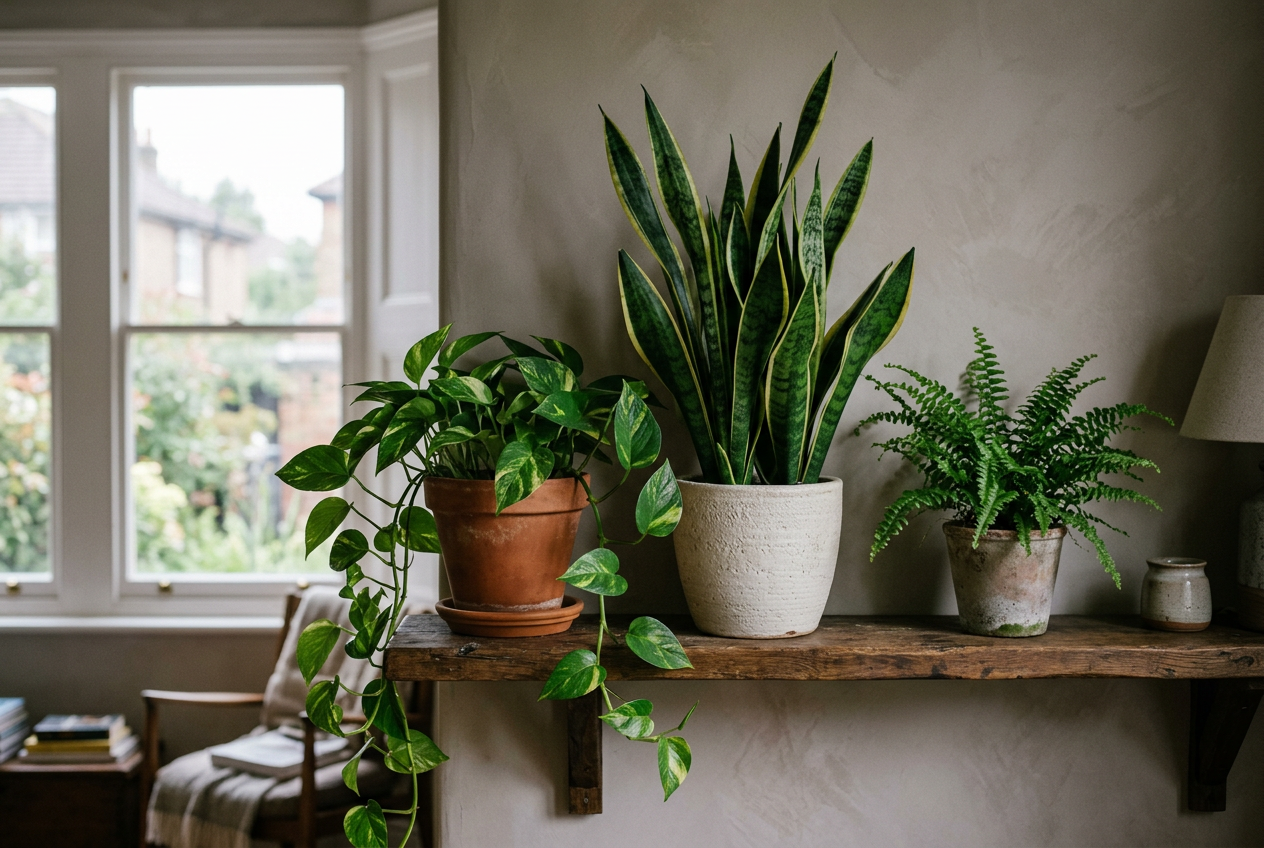
People who lose plant after plant usually blame themselves and conclude they have no knack for it. In flats, the real cause is almost always the same pair of factors: there is far less light than it looks like, and the watering routine was designed for a plant getting much more of it.
Fix the understanding of those two things and most of the rest sorts itself out.
Your eyes are lying about the light
Human vision adapts logarithmically, so a room that feels adequately bright to you can be delivering a fraction of what a plant needs. The numbers are startling.
Direct summer sunlight outdoors is roughly 100,000 lux. A bright spot on a windowsill might be 10,000. Two metres back from that same window, in the same room, you are often down to 500 to 1,000 lux. A shelf on the opposite wall can be under 200.
Light falls off with roughly the square of the distance from the window, so moving a plant one metre further into the room can cut its light by three quarters. That single fact explains most indoor plant failure, because the plant that thrived on the sill and then got moved to look nicer on the bookshelf did not change its requirements when it moved.
Measure rather than guess. A free lux meter app on a phone is not laboratory-accurate but it is easily good enough to compare positions, and it will change where you put things.
Which direction your windows face
South-facing windows in the northern hemisphere give the strongest, longest light. West gives strong afternoon sun that can scorch. East gives gentle morning light that suits most plants well. North gives soft, consistent, low light all day.
Then subtract for the things nobody accounts for: a building opposite, a balcony above, trees, net curtains, and modern low-emissivity glazing, which filters a meaningful portion of the spectrum. A north-facing window with a building four metres away is a very dim location no matter what the plant label says.
Seasons matter too. In London, Toronto or Seattle, December light is a small fraction of June light and the days are short. A plant that was fine in September can be badly underlit by November, which is when most houseplants actually die — people keep watering on the summer schedule while the plant has effectively stopped growing.
Overwatering is a light problem in disguise
Roots take up water to supply photosynthesis. Less light means less photosynthesis, which means less water used, which means compost stays wet for longer. Wet compost excludes air, roots suffocate and rot, and the plant wilts — which looks exactly like thirst.
So the classic low-light death spiral is: plant droops, owner waters, roots rot further, plant droops more.
Stop watering on a schedule. Check instead. Push a finger two inches into the compost; if it is damp, wait. Lift the pot — a dry pot is noticeably lighter, and this is the most reliable test there is once you know what a given plant feels like wet. In a dim room in winter, many plants want water once every two or three weeks rather than weekly.
Water thoroughly when you do, until it runs from the drainage holes, then empty the saucer after ten minutes. A pot standing in water is the fastest way to lose a plant.
Two more rules that matter in flats. Every pot must have drainage holes — a decorative cachepot with no hole is a reservoir. And stop feeding from October to March in northern latitudes, because fertiliser given to a plant that is not growing accumulates as salt in the compost and burns the roots.
Choose plants that suit the room you have
Plenty of houseplants evolved on forest floors under a canopy, and those are the ones to buy for a dim flat.
For genuinely low light, the reliable group is snake plant, ZZ plant, cast iron plant, pothos, heartleaf philodendron, spider plant and peace lily. These tolerate low light and irregular watering, which is the combination most flats actually offer.
For medium, bright-indirect positions within a metre of a window, add monstera, rubber plant, dracaena, calathea and most ferns — though ferns want humidity as well as light.
The ones to avoid in a dark flat, whatever the shop says, are fiddle leaf fig, most succulents and cacti, string of pearls, and croton. Succulents in particular are sold everywhere and are among the worst choices for a north-facing room; they stretch, go pale, flop and then rot.
If the room has no usable light at all, a grow light is not an indulgence. A small LED bar on a timer for eight to twelve hours a day costs $30 to $60 and turns a dead corner into a workable position.
The short version
Measure the light, move plants closer to the window than instinct suggests, water by weight rather than by calendar, and buy species matched to what the room actually offers. Almost nobody has a black thumb. Most people have a bookshelf on the wrong wall.
How do I know if a plant needs more light?
Watch the growth, not the leaves alone. Long gaps between leaves on a stretched stem, new leaves noticeably smaller than old ones, loss of variegation in a patterned plant, or a plant leaning hard toward the window all mean it is underlit. Move it closer to the glass before you change anything else.
Do grow lights actually work in a normal flat?
Yes, provided they are close enough. Light intensity drops sharply with distance, so a bar sitting 12 to 18 inches above the foliage does far more than a brighter fixture on the ceiling. Run it on a timer for eight to twelve hours, and choose full-spectrum white rather than pink-purple if the plant is in a living space you use.
Why do my plants die every winter?
Almost always because the care stayed the same while the conditions changed. Light is a fraction of summer levels and growth slows or stops, so water needs drop sharply and feeding should stop entirely. Move plants closer to windows for the season, keep them off cold glass and away from radiators, and cut watering frequency roughly in half.